
Carbon Reduction Plan
Supplier Name: Lagan Aviation & Infrastructure Limited
Publication Date: 19/11/2025
Publication Date: 02/09/2026
Commitment to achieving Net Zero
Protecting the natural and human environment is an important part of how we do business. We believe that carbon reduction measures are good for the environment and business. Through a reduction in fuel usage, we not only reduce our carbon equivalent emissions but also reduce the cost of construction. It pushes us to innovate and improve the way we work to deliver lower carbon products and services. Lagan Aviation and Infrastructure Ltd is committed to achieving Net Zero emissions by 2050.
Baseline Emissions Footprint
Baseline emissions are a record of the greenhouse gases that have been produced in the past and were produced prior to the introduction of any strategies to reduce emissions. Baseline emissions are the reference point against which emissions reduction can be measured. Covid-19 had a heavy impact on the aviation industry and in turn our business, resulting in low emissions reporting for year 2019 to 2021.
For a more accurate reflection of our emissions, we have moved our baseline year from 2021/2022 to 2022/2023 to cover a full year of operations.
Baseline Year: 2022/2023
Additional Details relating to the Baseline Emissions calculations.
We had recorded out emissions for Scope 1 (direct from fossil fuels consumption), Scope 2 (indirect from procured energy) and Scope 3 emissions which consist of C Category 6 (Business Travel) and Category 7 (Employee Commuting). We are still working with our supply chain to ensure accurate reporting of Category 4 (Upstream transportation and distribution) and will be updated and reflecting once we are able to establish this. Category 9 (Downstream transportation and distribution) is not applicable to our business as we produce our products for use on site, only in quantities required to complete the works. Material are laid on site with no requirements to be transported for sale.
We are continuing to work with our fuel providers, waste management contractors and supply chain partners to gather scope 3 emissions data accurately and consistently and to encourage a commitment from them to contribute to our shared commitment to monitor, report and reduce carbon emissions associated with the works.
Baseline year emissions:
Total Emissions
EMISSIONS
6,208.78 (includes procured fuel to run our sites, plants and equipment) .
Scope 1
108.2 (includes procured energy for our offices and sites that are connected to the electric grid)
Scope 2
314.81 (includes employee commuting and business travel)
Scope 3 (Included Sources)
6,631.79 tCO2e
TOTAL (tCO2e):
Current Emissions Reporting
To improve accuracy of reporting, we will ensure data is available and monitored on a monthly basis, as far as possible. There may be lag in certain data such as utility bills, which are provided quarterly.
Reporting Year: 2024/2025
TOTAL (tCO2e):
EMISSIONS
6,210.03 (includes procured fuel to run our project accommodations and welfare, plants and equipment) .
Scope 1
2.52 ((include procured energy to run our offices, offices and sites that are connected to the electric grid)
Scope 2
3,034.62 (includes employee commuting, business travel and well to tank emissions associated with fuel)
Scope 3 (Included Sources)
9,247.17
Total Emissions
Emissions reduction targets
We have set a target to reduce our emissions, to meet our target of Net Zero by 2050. We have set a target to reduce our scope 1 and scope 2 emissions (based on intensity) year on year and have set short, medium and long term plans (detailed below).
Limitations to meeting our reduction targets
Due to the location of our some of our international projects, access to alternative fuel sources is a challenge. This results in heavier reliance on diesel to run our project sites.
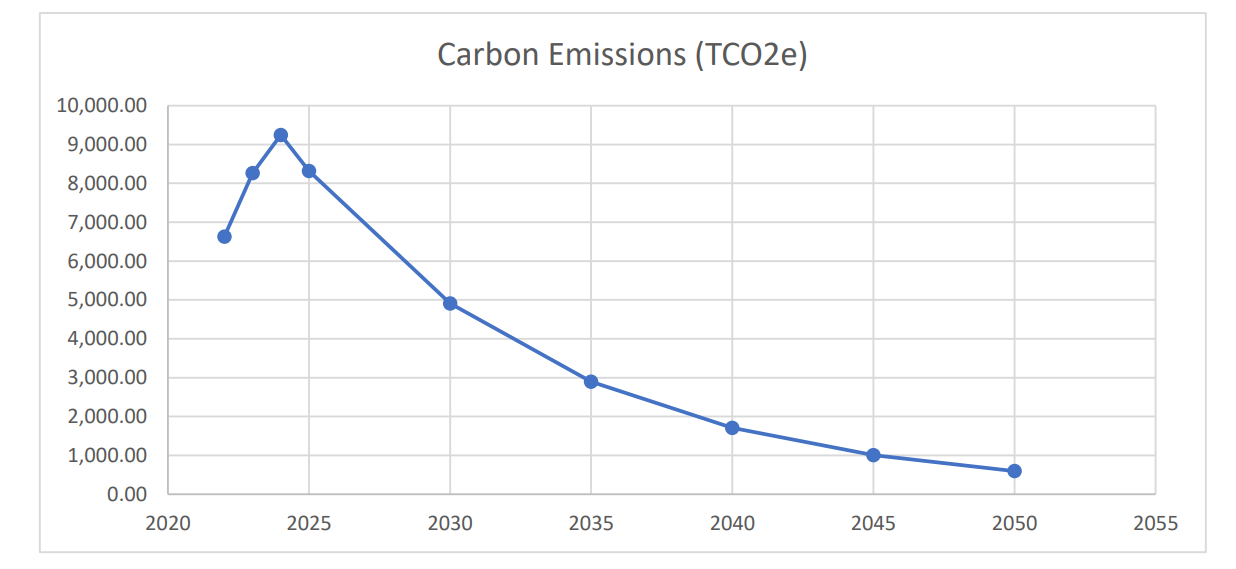
As we continue to improve the accuracy and consistency of our reporting, we will include wider categories of Scope 3 data, resulting in an increase in emissions reported compared to the baseline year. In our baseline year, our scope 3 emissions included only employee travel and commuting. This year, we included the well to tank emissions associated with fuel on our projects.
The graph below shows the emissions produced in our baseline and reporting year, followed by a 5 year cycle forecast. Due to the nature of the business, fluctuations are expected for our absolute emissions data.
Carbon Reduction Projects
Completed Carbon Reduction Initiatives
The following environmental management measures and projects have been completed or implemented since our 2022/2023 baseline:
Setting objectives for continuous improvement and monitoring against them
Maintenance of our ISO 14001 accreditations
Using the BREEAM Infrastructure framework on larger projects to ensure good sustainability and carbon management on our projects
Investment in technology to accommodate virtual meetings to minimise employee travel
Implementation of Electric Car Scheme to encourage employees to switch over to electric cars. Based on the average 12,000 miles travel for an employee, switching from an average sized diesel car to an electric car would result in an average saving of 2,712.71 kgCO2e.
Future Carbon Reduction Initiatives
The carbon emissions for year 2024/2025 shows a similar scope 1 emissions in spite of an increase in number of projects. This is partially due to the introduction of HVO and hybrid construction plant on a few of our projects as a trial.
Short Term (<3 years)
Liaise with our client to allow connection to the electrical grid where existing infrastructure is in place.
Installation of shelters for aggregate storage bays to reduce the heating oil associated with drying out the aggregates.
Continue to use biodiesel and source alternative fuel sources across our project sites
All project sites to be set up using eco-cabins with resource saving technologies such as motion sensor lights, LED lights, time heated controls, better insultation, natural ventilation, automatic shut off systems, EV charging points, waterless urinals, etc.
Reuse and recycling of greywater on sites as water suppression
Supply chain appraisal to include requirement to net zero targets and publications of a carbon reduction plan
Increase carbon literacy and awareness of employees and supply chain through engagement and training
Where practicable, hired plant to be electric or hybrid
100% of generators on site to be hybrid (solar powered with battery packs)
Reduce travel to sites through use of technology
More accurate monitoring of carbon through the use of SMARTWaste to develop a better understanding of our emissions.
Medium term (3 to 10 years)
When current owned plant are due for replacement, selection of fuel efficient or hybrid variety (when available on the market)
Work with client to design lower embodied water concrete and reduced temperature asphalt, while meeting technical specifications
When due for replacement, electrification of company fleet
Work with clients and designers to increase use of recycled aggregate and materials to make new products
Engage with supply chain partners to encourage monitoring and reporting of their carbon emissions
Asphalt burners to be converted to electric or gas to minimise the emissions associated with using kerosene and heating oil.
Long term (>10 years)
When available in the market, new plant to be of electric and hybrid only
All sites to be run on renewable energy
Supply chain appraisal to include requirement for net zero targets and publications of carbon reduction plan
Declaration and Sign Off
This Carbon Reduction Plan has been completed in accordance with PPN 006 and associated guidance and reporting standard for Carbon Reduction Plans.
Emissions have been reported and recorded in accordance with the published reporting standard for Carbon Reduction Plans and the GHG Reporting Protocol corporate standard and uses the appropriate government emission conversion factors for greenhouse gas company reporting.
Scope 1 and Scope 2 emissions have been reported in accordance with SECR requirements (where required), and the required subset of Scope 3 emissions have been reported in accordance with the published reporting standard for Carbon Reduction Plans and the Corporate Value Chain (Scope 3) Standard.
This Carbon Reduction Plan has been reviewed and signed off by the board of directors (or equivalent management body).
Scope 1 and Scope 2 emissions have been reported in accordance with SECR requirements, and the required subset of Scope 3 emissions have been reported in accordance with the published reporting standard for Carbon Reduction Plans and the Corporate Value Chain (Scope 3) Standard .
This Carbon Reduction Plan has been reviewed and signed off by the board of directors (or equivalent management body) for financial year dated April 2024 to March 2025.
Signed on behalf of the Supplier:
Steve Turner
Managing Director
Date: 02/09/2026
To reduce our emissions for 2024/2025, we have implemented the following on our projects:
Use of eco-cabins for our projects which are equipped with energy saving technologies such as motion sensor lights, LED lights, timed heating controls and better insulation. By using ecocabins, we saved (based on the information provided by our supplier), on average 89,527kgCO2e on each project site.
Development and implementation of project specific Carbon Reduction Plans on our projects
Use of hybrid powered construction plant and equipment, where possible.
Allowance for hybrid working for employees whose roles do not require them to be on site to reduce commuting required
Reuse of materials on site to reduce use of virgin material and reduce the number of heavy good vehicles deliveries
Solar powered laboratories
Fuel part of our operations using HVO
Planning works to allow for the HGV delivering materials to site also removes an equivalent load of construction and demolition waste that cannot be reused on site, halving the number of HGV movements.
Work with our design partners to retain existing infrastructure, allow the reuse of materials as part of new material specifications and implement lower carbon technologies
Application of CL:AIRE code of practice and the Quality Protocol for the reuse of soils and excavated materials on site
Trial of concrete washout treatment to enable the recycling of greywater for use as water suppression.
